
CURRENT EXHIBITION


Installation views taken by Thomas Barratt

SUMMER PLAYGROUND
VINCENT CHONG, AYA FUJIOKA, ALEXA HOYER, YASUSHI IKEJIRI, JAMES ISHERWOOD, ÉTIENNE KRÄHENBÜHL, ASTRID KÖPPE, NORIHIKO SAITO, TAKASHI SETO, HOMER SHEW, ASAKO TABATA, DANIELLE WINGER, AMI YAMASHIRO
July 13 – August 28, 2026
SEIZAN Gallery is pleased to present SUMMER PLAYGROUND, a group exhibition with works by Vincent Chong, Aya Fujioka, Alexa Hoyer, Yasushi Ikejiri, James Isherwood, Étienne Krähenbühl, Astrid Köppe, Norihiko Saito, Takashi Seto, Homer Shew, Asako Tabata, Danielle Winger, and Ami Yamashiro. Spanning painting, photography, sculpture, textile, and mixed media, the works converge in a shared sensitivity to memory, material transformation, and the shifting boundaries between abstraction and
representation.
Vincent Chong (b. 1992, Binghamton, NY)
Vincent Chong is a San Francisco–based multidisciplinary artist whose practice spans performance, calligraphy, seal carving, painting, and drawing, exploring the intersections of queer identity, community, and traditional Chinese cultural forms. The exhibition features a portrait that conveys intimacy and melancholy, evoking the pleasant exhaustion that settles in after a long summer day. Chong's recent exhibitions include LIFE STUDIES at SEIZAN Gallery, New York, and presentations at the Metropolitan Museum of Art, La MaMa Galleria, and Lehman College Art Gallery. Chong has participated in residencies including the International Studio & Curatorial Program (ISCP), Fire Island Artist Residency, and the Center for Book Arts.

Vincent Chong, Brian with afternoon light, 2023, Pastel on paper, 19.5 x 25.5 in (49.5 x 64.8 cm)
Aya Fujioka (b. 1972, Hiroshima, Japan)
Aya Fujioka is a photographer based in Kyoto and Hiroshima whose intimate, narrative-driven images explore how personal chronicle opens onto the collective memory of communities, within the Japanese photobook tradition. Selected works from her newly published series LIFE STUDIES offer intimate documentation of her diasporic life in New York during the 2000s and 2010s. Fujioka's work is currently featured in the group show I'm So Happy You Are Here, an extensive survey of female photographers in post-war Japan at the Bunkamura Museum in Tokyo. She is the recipient of the prestigious Kimura Ihei Photography Award for her 2018 photobook Here Goes River (Akaaka). Her work is held in the collections of the San Francisco Museum of Modern Art, the Tokyo Photographic Art Museum, and the 21st Century Museum of Contemporary Art, Kanazawa.

Aya Fujioka, Life Studies (66), 2008, Chromogenic print, 11 x 14 in (27.9 x 35.6 cm)
Alexa Hoyer (b. Hamburg, Germany)
Alexa Hoyer is a visual artist and curator based in New York whose photographic projects explore overlooked or ephemeral aspects of urban and rural environments, capturing unexpected narratives found in public and often unconventional spaces. Targets is a striking series capturing makeshift gun targets—wooden cutouts, plastic containers, old signs—left behind at unregulated shooting sites in the Nevada desert. Hoyer's images draw out the eerie beauty, absurdity, and tension embedded in these bullet-riddled relics. Her work has been exhibited internationally, including at PS122 Gallery (NY), Mana Contemporary (NJ), the Contemporary Arts Museum Houston (TX), and Les Rencontres d'Arles (France), among others.

Alexa Hoyer, Tank on Frame, 2023, Edition of Edition of 5 + 2 AP, Archival Pigment Print, 30 x 24 in (76.2 x 61 cm)
Yasushi Ikejiri (b. 1971, Hokkaido, Japan)
In his signature Candy Wrapper series, Japanese painter Yasushi Ikejiri renders empty packaging discarded on Tokyo streets in meticulous detail with rich colors, evoking nostalgia and dystopia at once. The triptych Nostalgic Flavor distills the idea further, isolating chewing gum wrappers against solid backgrounds. Ikejiri treats mass-produced packaging as worthy of monumental attention—yet his nostalgic warmth lies closer to Wayne Thiebaud's lovingly rendered confections than to Pop's cool detachment. Ikejiri's recent exhibitions include With Fallen Leaves at SEIZAN Gallery, New York; Traces of Dreams at SEIZAN Gallery, Tokyo; and Where We Are Not at SEIZAN Gallery, New York.

LEFT Yasushi Ikejiri, Nostalgic Flavor 1, 2024, Oil and acrylic on wood panel, 28.7 x 40.6 x 1.2 in (72.8 x 103 x 3 cm)
MIDDLE Yasushi Ikejiri, Nostalgic Flavor 2, 2024, Oil and acrylic on wood panel, 28.7 x 40.6 x 1.2 in (72.8 x 103 x 3 cm)
RIGHT Yasushi Ikejiri, Nostalgic Flavor 3, 2024, Oil and acrylic on wood panel, 28.7 x 40.6 x 1.2 in (72.8 x 103 x 3 cm)
James Isherwood (b. 1971, Boston, MA)
New York–based painter James Isherwood creates extraterrestrial landscapes, architectural forms, and abstractions in vivid colors and meticulous brushwork, blurring the boundaries between observation and imagination. Two abstractions from 2023, Nefarious and Guardian, begin with liquid paint flung vigorously across wood panel or paper and spread with paper towels, then are enriched with painstaking brushwork—chance and the artist's hand together generating a taut sense of tension and depth. Isherwood's recent exhibitions include the solo presentation THAW at SEIZAN Gallery New York and James Isherwood at Susan Eley Fine Art. He has solo exhibitions forthcoming at SEIZAN Gallery in both New York and Tokyo this fall.

James Isherwood, Guardian, 2023, Acrylic on paper, 22.125 x 30 in (56.2 x 76.2 cm)
Étienne Krähenbühl (b. 1953, Vevey, Switzerland)
Étienne Krähenbühl is a Swiss sculptor whose practice explores movement, sound, time, and transformation through the use of industrial materials, often combining scientific research with poetic inquiry. Working across kinetic, sonic, and monumental sculpture, he investigates the expressive potential of matter, the traces of memory embedded within it, and how it resonates with its natural or architectural environment. Best known for his public installation Big Bang, a monumental sculpture at the Château de Vullierens in Switzerland, Krähenbühl has exhibited extensively for decades, including Disparition et Réminiscence in La Sarraz and Arts du Feu at the HR Giger Museum, with forthcoming presentations in Switzerland in 2026.

Étienne Krähenbühl, Citron peu pressé (Somewhat Pushed Lemon), 2019, Iron, stainless steel, nickel titanium, 17.3 x 15.7 x 8.3 in (43.9 x 39.9 x 21.1 cm)
Astrid Köppe (b. 1974, Köthen, Germany)
Astrid Köppe, a Berlin-based artist, has devoted herself to a single format of drawing for over twenty years: biomorphic shapes meticulously rendered at the center of vertical white paper. The practice has also expanded into a larger, more materially grounded form—vitreous enamel on steel plates, a technique traditionally used for industrial signage. Working across these two materials, Köppe weaves riddles that unsettle the viewer's perception, evoking nostalgia while simultaneously summoning memories of the future. Köppe's work has been actively exhibited in the United States, Europe, South Korea, and Japan. Recent solo exhibitions include Frodeman Gallery, Jackson, WY; ten to the n, Seoul, South Korea; Kunstverein Landshut, Germany; Gallery Sekiryu, Nagano, Japan; and SEIZAN Gallery, New York.
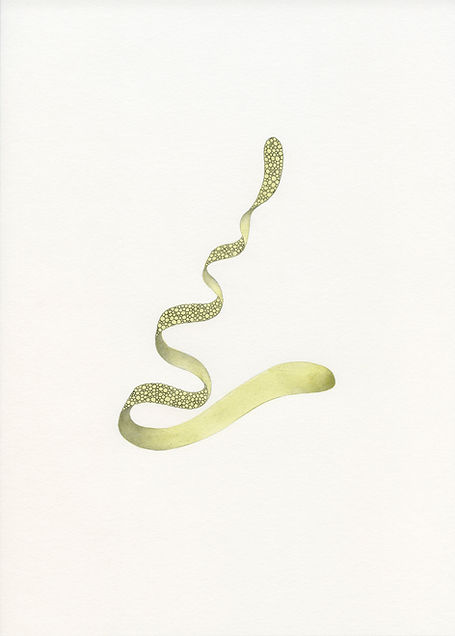
Astrid Köppe, Untitled (Z22_126), 2022, Watercolor and pencil on paper, 11.7 x 8.3 in (29.7 x 21.1 cm)
Norihiko Saito (b. 1957, Kanagawa, Japan)
Norihiko Saito is a Japanese painter known for his contemporary approach to Nihonga, traditional Japanese painting. Influenced early in his career by the landscapes of modern masters like J. M. W. Turner, Saito blends traditional materials and techniques with expansive, atmospheric compositions that explore memory, nature, and spiritual experience. Recently retired after decades at Tokyo University of the Arts, where he holds the title of Professor Emeritus, Saito has exhibited widely in Japan and abroad, including at the National Museum of Modern Art, Tokyo; the Zhejiang Art Museum in Hangzhou; and the Tokyo Metropolitan Art Museum. His work is held in public collections including the National Museum of Modern Art, Tokyo; the Yamatane Museum of Art; the Yokohama Museum of Art; and the Museum of Contemporary Art Tokyo.

Norihiko Saito, WL-015, 2025, Natural mineral pigment, pigment, metal paint on silk mounted on wood panel, 35.8 x 23.9 in (91 x 60.6 cm)
Takashi Seto (b. 1974, Saitama, Japan)
Drawing on his extensive experience as a textile craftsman, Takashi Seto revives and reinterprets historical Yuzen dyeing and metal-leaf techniques, transforming traditional craft processes into contemporary art pieces that explore time, memory, and cultural heritage. Working with silk, dye, natural pigments, urushi lacquer, and silver leaf, he creates layered and intricate compositions that evolve as their materials age. Recent exhibitions include Moments of Arrival at SEIZAN Gallery, New York, his first solo exhibition in the United States, as well as presentations at the Tomioka Silk Mill and FEI Art Museum Yokohama in Japan. Seto is a designated Traditional Craftsman of the Kumagaya dyeing tradition.

Takashi Seto, Unseen, 2023, Lacquer, silver leaf, artificial dye on silk mounted on wood panel, 39.4 x 55.1 x 1.2 in (100 x 140 x 3 cm)
Homer Shew (b. 1990, Chicago, IL)
New York–based artist Homer Shew explores identity, community, and lived experience versus imposed narratives through portraits of Asian Americans and the Asian diaspora within the art community. Painted from photographs he takes of his subjects in their everyday settings, Shew's portraits are rich in color with bold brushstrokes, capturing a moment of candid expression and inviting connection and conversation with the sitter. Recent exhibitions include From Being Jealous of a Dog's Vein at Kiang Malingue, New York; See and Be Seen 2.0 at Praise Shadows Gallery, Brookline, MA; and Responses: Asian American Voices Resisting the Tide of Racism at Manchester Public Library, Vermont, among others.

Homer Shew, Layla Wolfgang, 2021, Oil on Canvas, 18 x 24 x 1.6 in (45.7 x 61 x 4.1 cm)
Asako Tabata (b. 1972, Kanagawa, Japan)
Asako Tabata creates paintings and papier-mâché sculptures of women, children, and spectral figures rendered in the charged brushwork of oil paint. While her imagery is often drawn from her everyday life and household, her own mother has become a recurring subject. Bye Bye (2024) depicts a ghostly figure on a boat crossing a vast expanse, waving toward "this side," where a hand emerges and waves back. Created shortly after Tabata's mother passed away, the work reflects the Japanese Buddhist notion of crossing a river to the other side after death. Building on this painting, Tabata created a monolithic sculpture, Ascending to Heaven (2025), shaped like a temple bell, holding within it dozens of papier-mâché figures aboard a boat. Since her US debut in 2021 with SEIZAN Gallery New York, Tabata's work has been exhibited in numerous solo and group shows. Her solo exhibitions have been reviewed by the acclaimed critic John Yau in Hyperallergic, and her work is held in notable private collections in the US.
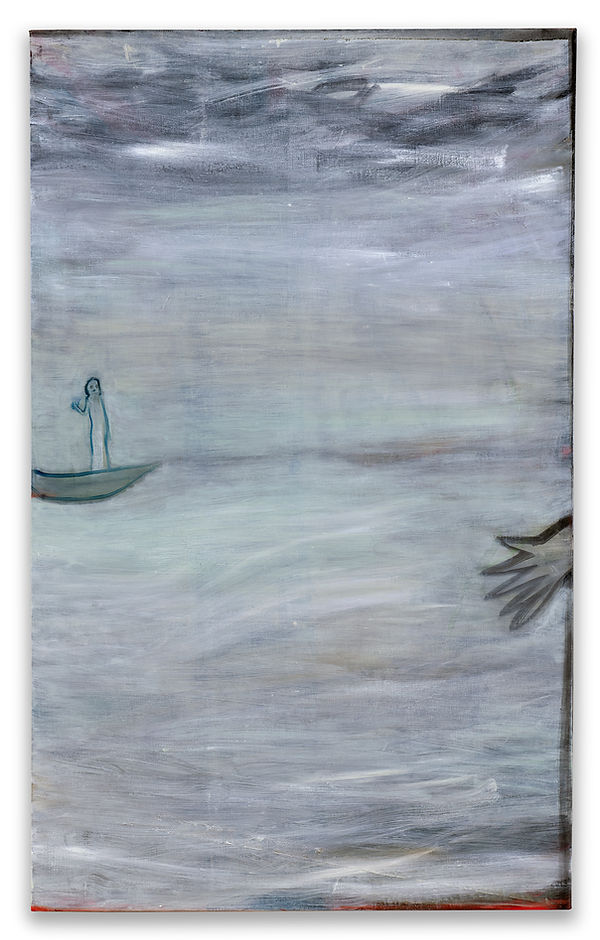
Asako Tabata, Bye Bye, 2024, Oil on canvas, 51.3 x 31.6 x 1 in (130.3 x 80.3 x 2.5 cm)
Danielle Winger (b. 1986, Reno, NV)
Danielle Winger creates emotionally resonant landscape paintings that honor the natural world as both itself and a metaphor. Shaped by the spirit of German Romanticism, her work treats landscape as a vessel for emotion and memory as much as a physical space. Seeking the solace of empty places, Winger paints intensely personal portraits of quiet, meditative spaces that invite contemplation of the self, the sublime, and the divine. Winger has exhibited widely in the US and abroad, including solo exhibitions at SEIZAN Gallery, Tokyo, and Visions West Contemporary in Denver and Livingston, and group presentations in Munich, London, Paris, Taipei, and New York. Her work has been featured in New American Paintings, ArtMaze Mag, and Create! Magazine, among others.

Danielle Winger, River Breadth, 2025, Oil on canvas, 28 x 22 in (71.1 x 55.9 cm)
Ami Yamashiro (b. 1987, Fukuoka, Japan)
Ami Yamashiro creates mezzotints and oil paintings that merge a Victorian atmosphere with a contemporary sensibility, depicting absurd, Kafkaesque tableaux that frequently center on young girl figures. Drawn to mezzotint for the way it mirrors her instinct to begin each work in darkness—roughening a copper plate to a fully black surface, then coaxing an image into being through smoothing and burnishing—Yamashiro exploits the medium's rich blacks and subtle tonal gradations to striking psychological effect. She made her US debut in 2021 in the group exhibition Bedtime Stories at SEIZAN Gallery New York, followed by her first US solo exhibition, Pragmatism, at the gallery in 2026.
